How it works
Real hormones, read at home from a drop of saliva.
Your hormones shape your whole day, and you almost never get to see them. Most people get one or two blood tests a year. OM turns it into something you can do twice a day.
How a read works
Swab. Insert. Read.
01
Swab
Hold the collector in your mouth for ten seconds. No blood, no needle.
02
Insert
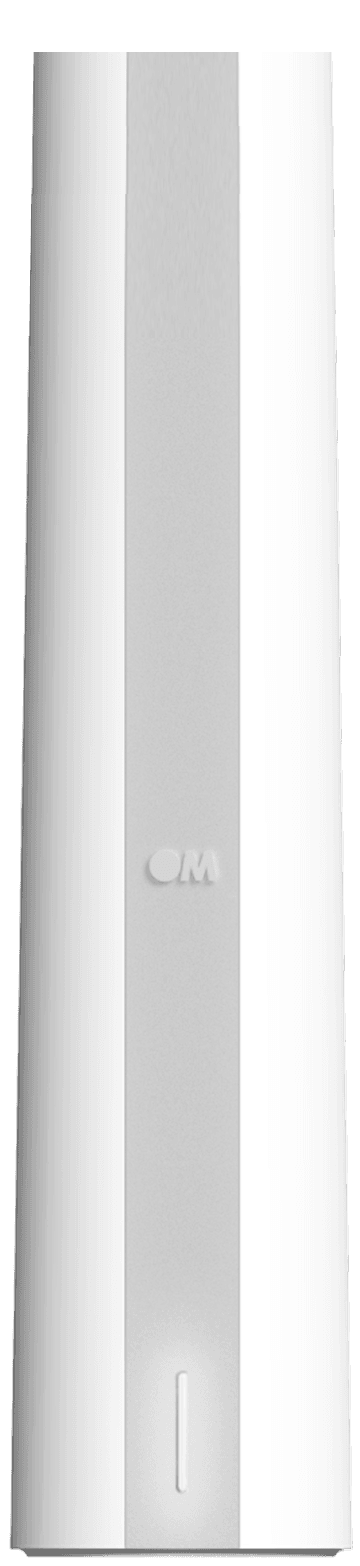
Slide it into the reader on your counter.
03
Read
Your levels, and what to do about them, in under a minute.


The technology
We read your biology electrically.
Most home tests change colour, and a camera or your eye reads the colour. That struggles with the tiny amounts hormones come in, and it reads one thing at a time. Our patented chip turns a hormone landing on it straight into an electrical signal. No colour, no camera, no needle.
01Multiplex
One swab, several molecules
A ten-second saliva swab carries many biomarkers at once. A single cartridge reads three to five of them together, not one strip per molecule.
3–5 markers / swab
02Sensitivity
They bind at the transistor
Each molecule binds at the surface of a patented organic transistor (the OEGFET), detected down to femtogram-per-millilitre levels, sensitive enough to read large proteins optical strips and many blood tests miss.
down to fg · mL⁻¹
03Speed
Binding becomes a signal
The transistor turns binding directly into an electrical signal: no camera, no colour change, no ambient light. A result comes back in under a minute, at a target of a few dollars per test.
result in < 60 s
04Architecture
One core, many cartridges
The same sensing core powers an open-ended roadmap of cartridges, so the platform expands to new panels without ever being rebuilt.
1 core → ∞ panels
Grounded in science
Not a concept. A published, patented sensor.
Published
In a Nature Portfolio journal
npj Biosensing, 2025: our sensor read saliva about as well as a gold-standard lab test.
Patented
A chip that reads hormones
It turns a hormone into an electrical signal. No colour strip, no camera, no needle.
In studies
Validated in clinical studies
Work with the Royal Ottawa and Bruyère is validating the core sensing technology.
Made in Canada
Invented at Carleton University
Built in the Organic Sensors and Devices Lab, backed by NSERC and CABHI.
Where the work stands
From paper, to prototype, to your counter.
Published
npj Biosensing, 2025
A Nature Portfolio journal published the sensor. In saliva it read about as well as the gold-standard lab test it was measured against.
Built
A working reader, at home
A finished consumer reader that measures cortisol and testosterone from a saliva swab.
In studies
Validated in clinical studies
Work with the Royal Ottawa, Bruyère and the CCNA COMPASS-ND cohort is validating the core sensing technology.
Protected
Patented technology
The sensor is patented, and was invented at Carleton University.
Funded in part by public research grants, including NSERC and the Centre for Aging + Brain Health Innovation (CABHI), and built on work at Carleton University. OM is a wellness product, not a medical device: it does not detect or diagnose disease.